AI-Assisted Quality Document Review
Find document-quality issues earlier. Review faster. Keep humans in control.
TrialVerity applies governed Review Standards to quality-sensitive documents, identifies evidence-backed issues, proposes controlled corrections, and keeps qualified reviewers in control of every final decision.
AI finds and proposes. Humans decide. TrialVerity records what happened.
Document sources
Prioritized findings
3 potential- Lesion length mismatchHigh
- Visit date out of sequenceMedium
- Unit inconsistencyReview
Why It Helps
Find Earlier. Fix Faster. Reduce Rework.
TrialVerity is designed to reduce repetitive manual review, surface quality issues before formal approval workflows and make reviews more consistent — while preserving human control and review evidence.
Reduce Review Effort
Automate repetitive first-pass checks so experts can focus on judgment.
Catch Issues Earlier
Surface missing criteria, unresolved placeholders, traceability gaps, inconsistencies, and ambiguous acceptance criteria before they move downstream.
Accelerate Finalization
Move from structured findings to human decisions and reviewable Word redlines in one controlled workflow.
Reduce Operational Effort
Reduce repetitive searching, reconciliation, correction cycles, and audit-history reconstruction where pilot results demonstrate value.
How It Works
From Document Draft to Human-Controlled Quality
- 01
Prepare
Upload/register the document, identify sensitivity, and confirm document type.
- 02
Govern
Apply the published, versioned Review Standard for that document type.
- 03
Review
AI evaluates the document against configured quality rules.
- 04
Ground
Findings are tied to source evidence and proposed edits are checked for safe placement.
- 05
Decide
A human reviewer Accepts, Rejects, or Modifies each finding.
- 06
Redline
Safely placeable corrections can become native Word tracked changes.
- 07
Audit
Review runs, configuration provenance, findings, and human decisions remain reconstructable.
TrialVerity does not autonomously approve or finalize regulated documents. Every proposed correction is a suggestion for a human reviewer.
Human Oversight
AI Assistance With Explicit Boundaries
TrialVerity assists qualified personnel. It does not autonomously approve or finalize regulated documents. Final review decisions remain with authorized customer personnel.
Evidence Before Conclusions
Findings show the source evidence that triggered the concern.
No Invented Engineering Facts
TrialVerity can identify missing information without fabricating the missing requirement, value, approval, or engineering decision.
Safe Placement Only
If TrialVerity cannot reliably determine where a proposed correction belongs, it does not guess.
Human Final Authority
AI recommendations do not approve or finalize controlled documents. Reviewers Accept, Reject, or Modify findings.
AI finds and proposes. Humans decide. TrialVerity records what happened.
What It Can Find
Designed to Surface the Issues That Create Rework
- Missing or weak acceptance criteria
- Unresolved TBDs and placeholders
- Missing requirement traceability
- Conflicting values or terminology
- Ambiguous pass/fail criteria
- Cross-document inconsistencies
- Missing required content
- Other document-type-specific quality rules
Controlled Corrections
From Finding to Human-Controlled Correction
TrialVerity separates identifying a problem from changing the document. Reviewers Accept, Reject, or Modify findings before completing human review. Safely located, reviewer-approved corrections can then be carried into a Reviewed Word Redline using native Microsoft Word tracked changes. Rejected changes are excluded, and TrialVerity does not guess when placement is uncertain.
Completing human review and generating the Reviewed Word Redline do not constitute document approval and are not an electronic signature.
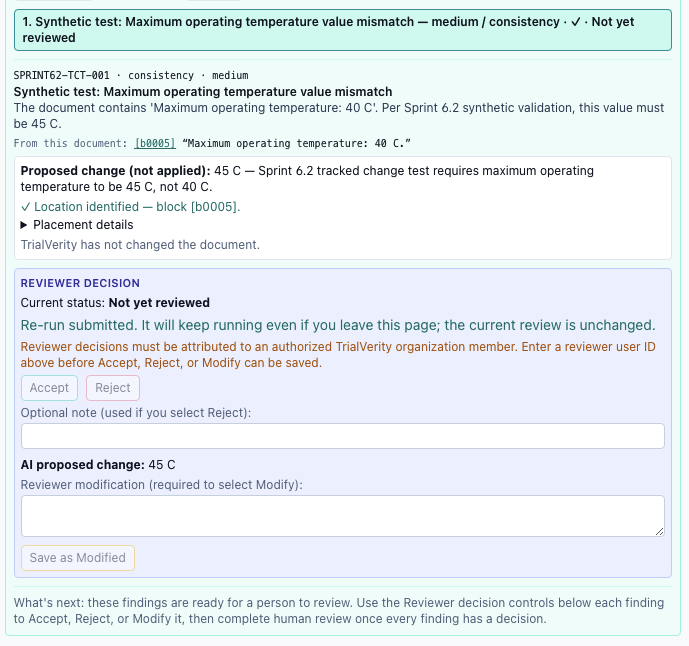
Qualified reviewers Accept, Reject, or Modify each finding before completing human review.
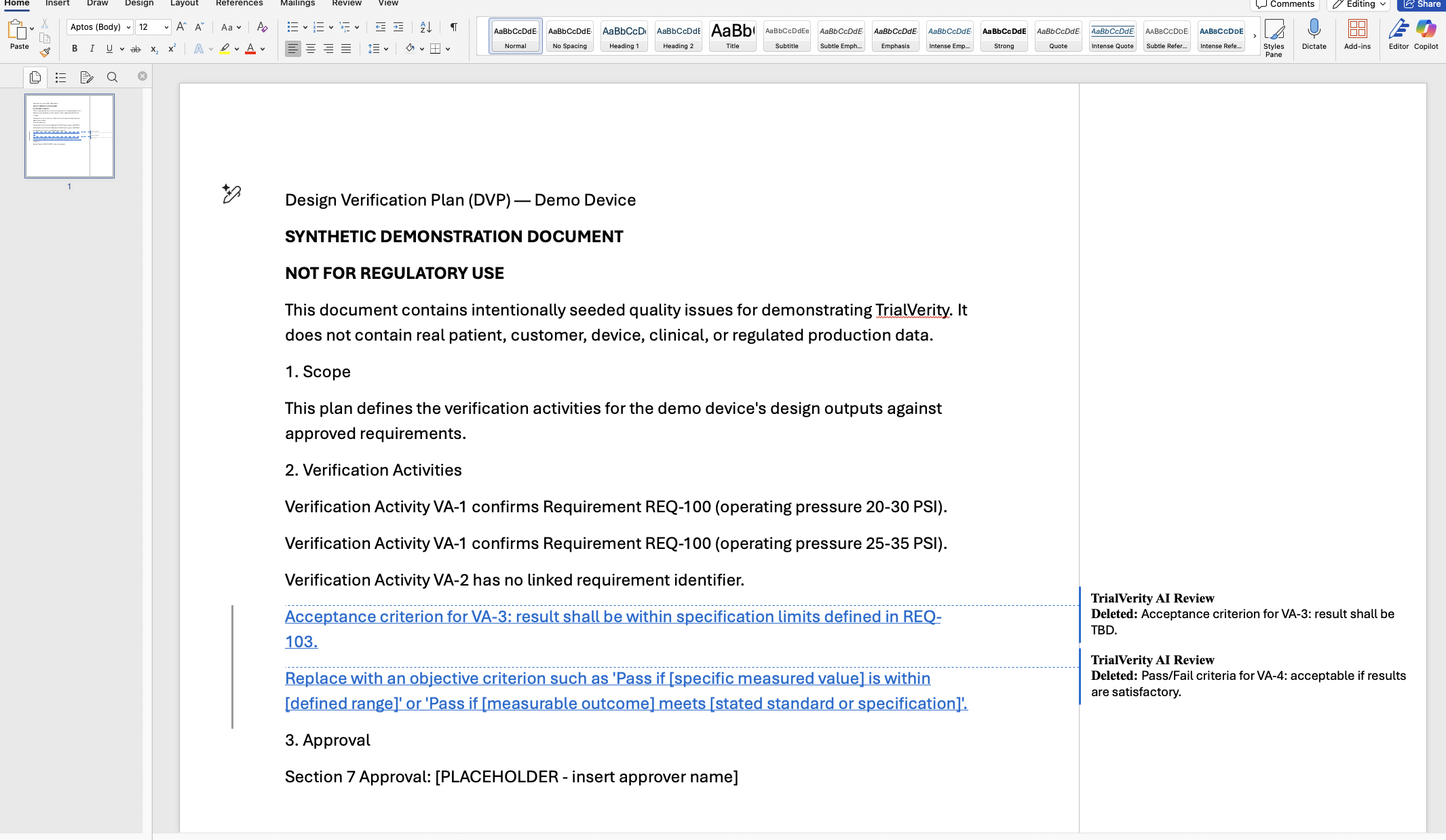
Reviewer decisions can be carried into a Reviewed Word Redline using native Microsoft Word tracked changes.
Document Coverage
One Review Platform. Multiple Controlled Document Families.
Requirements & Design
PRD, SRS, Design Specifications, Trace Matrices.
Verification & Validation
DVP, DVR, Software V&V, validation protocols/reports.
Manufacturing & Qualification
Validation Plans/Reports, IQ, OQ, PQ.
Clinical & Regulatory
Clinical plans/reports, CER and related regulated documentation.
Post-Market & Quality
PMS, PSUR and related quality documentation.
Review behavior is governed through document-type-specific Review Standards rather than a single generic AI prompt.
Customer Use Cases & Personas (opens PDF in a new tab) — See representative TrialVerity workflows, user personas and potential pilot scenarios.
Resources
Explore TrialVerity
Executive Overview
Short executive introduction to the business problem, TrialVerity approach, human-control model, and pilot framework.
Download Executive Overview (opens PDF in a new tab)Detailed Customer Solution Guide
Detailed explanation of the workflow, Review Standards, findings, controlled corrections, human review, Word redlines, cross-document review, governance, personas, and pilot measurement.
Download Customer Solution Guide (opens PDF in a new tab)Pilot Program
Start With a Controlled Pilot
Begin with 2–3 customer-approved, non-sensitive document types and measure TrialVerity against the organization’s existing review process.
What we measure together
- First-pass review time
- Meaningful issue detection
- False-positive rate
- Reviewer disposition time
- Correction/redline usefulness
- Rework/comment cycles
- Audit-evidence effort
- 01
Discovery
Understand where review effort goes today and how issues are currently found and resolved.
- 02
Historical Cases
Review a small number of representative, de-identified historical examples.
- 03
Proof of Value
Evaluate whether configured review requirements and AI-assisted analysis could identify known problems earlier.
- 04
Define V1
Use the findings to determine the appropriate production workflow, controls, architecture, and integration requirements.
Why start with a pilot?
Evaluate whether AI-assisted review can reduce repetitive manual review effort in your actual workflow, with qualified reviewers remaining in control throughout. A pilot does not establish regulatory compliance.
Start small. Validate against real problems. Build only what creates measurable value.
Evaluation Request
Request a 5-minute evaluation
Explore an AI-assisted review of a synthetic Design Verification Plan. Inspect findings, make review decisions, and download a reviewed Word document. No company documents required.
Pilot Request
Interested in a controlled pilot?
Tell us a little about your team and the workflow you’d like to improve. We read every submission.
Find the errors earlier.
Begin with a controlled pilot on a small set of document types and measure TrialVerity against your existing review process.
AI finds and proposes. Humans decide. TrialVerity records what happened.